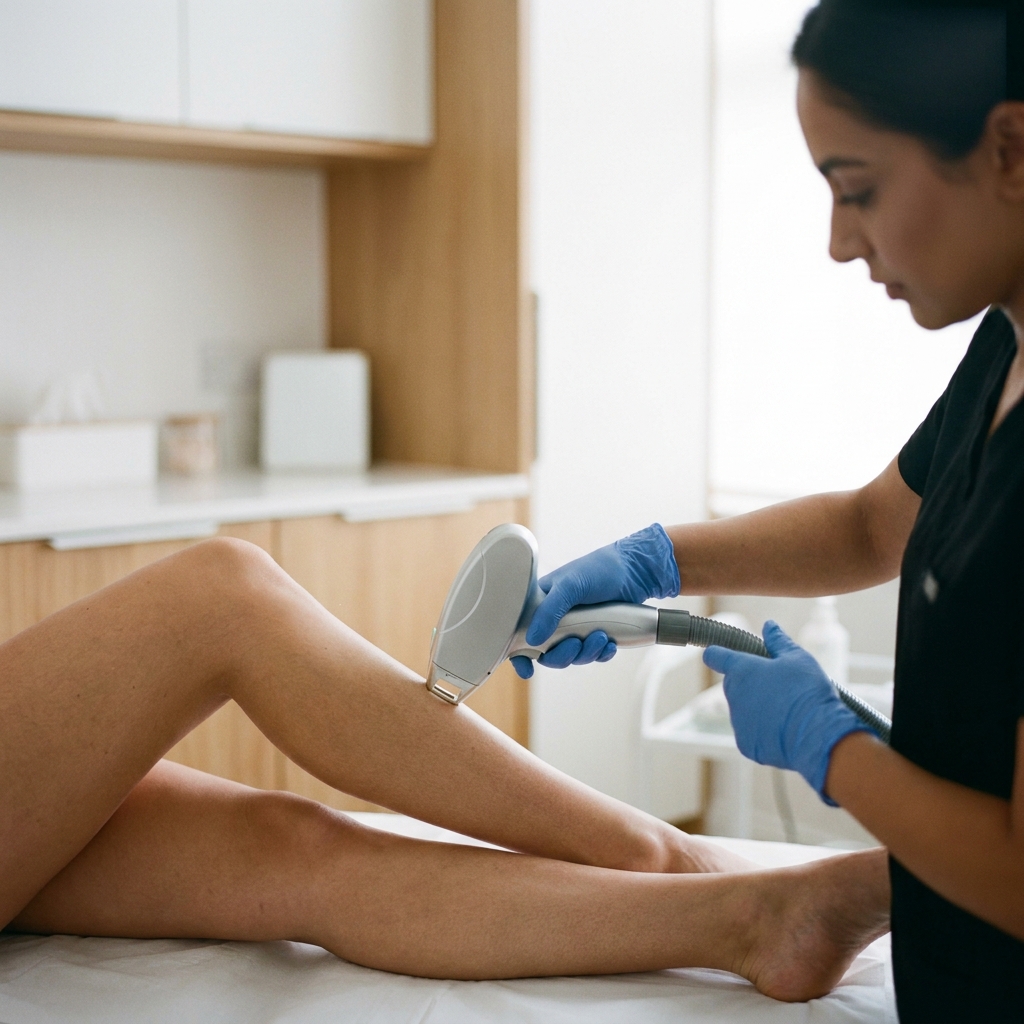
The short answer
For most people laser hair removal is uncomfortable rather than painful — the usual description is a quick ‘elastic band snap’ or hot pinprick against the skin as each pulse fires. Sensitive areas such as the upper lip, bikini line and underarms tend to feel sharper than the legs or arms. Modern devices with built-in cooling reduce the sting considerably. Pain varies a great deal between individuals, so discuss comfort options at your consultation and patch test.
“Will it hurt?” is one of the first questions people ask before booking. The honest answer is that laser hair removal does produce a sensation — the laser briefly heats the pigment in each hair follicle — but for most people it is a short, tolerable discomfort rather than genuine pain. How it feels depends on the area, your skin and hair, the device used and how well the skin is cooled. This page explains the sensation, what influences it and how to make sessions more comfortable.
Pain at a glance
- Typical sensation Brief ‘elastic band snap’ or hot pinprick
- Most sensitive areas Upper lip, bikini line, underarms
- Least sensitive areas Legs, arms, back
- Pain relief Built-in cooling; numbing cream per practitioner
- Session length A small area can take only minutes
What does laser hair removal actually feel like?
Each laser pulse delivers a brief burst of energy that is absorbed by the melanin (pigment) in the hair, heating the follicle until its ability to regrow hair is reduced. People most often describe the resulting sensation as a quick flick of a warm elastic band against the skin, or a brief hot pinprick. It lasts only a fraction of a second per pulse, and the device immediately moves on to the next area. Because the laser targets pigment rather than cutting, gripping or pulling the skin, the discomfort is quite different from waxing, where hair is yanked out from the root in one sharp tug — many people find laser more comfortable than waxing over a whole treatment.
Sensation varies widely from person to person. Some people barely notice it and happily read their phone throughout; others find certain spots genuinely sharp and need a moment between pulses. Both responses are completely normal and neither means anything is wrong. Your own experience will also depend on how anxious you feel, how well-rested you are, and how the skin is being cooled, so it is worth going in relaxed and well hydrated.
Which areas hurt more?
Discomfort tends to track three things: how thin the skin is, how close it sits to bone, and how dense and coarse the hair is. Bony, thin-skinned regions with strong hair feel sharper, while fleshier areas with finer hair are gentler. As a rough guide:
| Area | Typical comfort level |
|---|---|
| Upper lip / face | Sharper — thin skin, close to bone |
| Bikini line | Sharper — sensitive skin, coarse hair |
| Underarms | Moderate to sharp |
| Legs / arms | Mild — usually well tolerated |
| Back / shoulders | Mild to moderate |
If you are nervous about a particular area, a good practitioner will start gently, check how you are coping, and build up to the working settings, rather than going in at full energy from the first pulse.
What makes it more comfortable?
- Cooling. Most modern systems blow chilled air or use a contact cooling tip that numbs the skin as the laser fires — this is the single biggest comfort factor, and it also protects the skin surface.
- The right device and settings. A qualified practitioner adjusts the energy to your skin tone and hair type so treatment is effective without being needlessly harsh. Correct settings also reduce the risk of burns.
- Numbing cream. A topical anaesthetic can be considered for very sensitive areas, but only on a practitioner’s advice and applied exactly as directed — see numbing cream for laser hair removal.
- Timing. Skin can feel more sensitive at certain points in the menstrual cycle, so some people prefer to avoid those days for sensitive areas.
- Avoiding sun and tanning. Tanned skin is more reactive and uncomfortable; keeping skin its natural shade reduces both discomfort and risk — see sun exposure and laser hair removal.
- Steady breathing. Simply breathing out as each pass is made, rather than tensing, helps many people tolerate the sensation more easily.
Does it hurt more over a course?
Many people report that sessions become more comfortable as a course progresses, because there is steadily less hair to treat each time and the remaining hairs are often finer. A typical course is six to eight sessions spaced four to eight weeks apart, because the laser only affects hair that is in its active growth phase, so several sessions are needed to catch more follicles. The patch test you have before starting is also your first chance to feel the sensation on a small area and decide whether you are comfortable to proceed with a full session.
When discomfort is a warning sign
Normal discomfort settles the moment the pulse ends, leaving at most a brief warmth and some redness that fades within hours. Persistent stinging, intense burning, or pain that continues well after the session can signal that the skin has reacted too strongly. If that happens, stop and speak to your practitioner; if blistering or a possible burn develops, treat it as you would any skin injury and seek medical advice from a pharmacist, GP or NHS 111. Comfort and skin reactions are individual, so this page is general information, not medical advice — a consultation and patch test with a qualified, regulated practitioner are essential, and results and reactions vary from one person to the next.
Frequently asked questions
Is laser hair removal more painful than waxing?
Most people find it less painful than waxing because the skin is not pulled. Laser produces a brief snapping or pinprick sensation per pulse rather than the sharp tug of hair being removed from the root.
Can I take a painkiller before my session?
Ask your practitioner. Some people take an ordinary over-the-counter painkiller beforehand, but you should follow your clinic’s advice and the medicine’s instructions rather than self-medicating routinely.
Does numbing cream stop the pain completely?
It reduces discomfort but does not always remove it entirely, and it should only be used on a practitioner’s advice because over-application can cause its own problems. See our numbing cream page for details.
Why did one area hurt much more than another?
Thinner skin, areas close to bone, and coarse dense hair all feel sharper. Sensitivity also varies day to day and between individuals, which is completely normal.
Sources & further reading
- NHS — Laser hair removal and cosmetic procedures: what to consider
- MHRA — Regulation of lasers and intense pulsed light (IPL) devices
- JCCP — Patient guidance on choosing a cosmetic practitioner
- British Medical Laser Association (BMLA) — laser safety information for patients
This guide is general information, not medical advice. A patch test and consultation with a qualified, regulated practitioner are essential before treatment, and results vary by individual. Laser achieves long-term hair reduction, not guaranteed permanent removal of every hair. Discuss any skin or health concerns with the practitioner or your GP.