The short answer
Laser hair removal works by aiming a concentrated beam of light at the hair, where the pigment (melanin) absorbs the light and converts it to heat. That heat damages the follicle and slows or stops regrowth. Because the laser only affects hair that is in its active growth phase, several sessions are needed over months. It achieves long-term hair ‘reduction’ rather than guaranteed permanent removal of every hair, and works best where hair is darker than the surrounding skin.
Laser hair removal is one of the most common cosmetic procedures in the UK, yet how it actually works is widely misunderstood. The principle is a piece of physics called selective photothermolysis — using a precise wavelength of light to heat one target (the pigment in a hair follicle) without harming the skin around it. This page explains the mechanism step by step, why a course takes several sessions, and where the limits of the technology lie.
The mechanism at a glance
- Principle Selective photothermolysis
- Target Melanin (pigment) in the follicle
- Effect Heat damages the follicle, slowing regrowth
- Active phase Only works on hair in the anagen growth stage
- Typical course 6–8 sessions, 4–8 weeks apart
- Outcome Long-term reduction, not guaranteed permanence
The basic principle: light becomes heat
Every hair grows from a follicle — a small pocket in the skin containing the cells that produce the hair. Laser hair removal relies on a single idea: the dark pigment called melanin, which gives hair its colour, absorbs light very efficiently. When a laser fires a precise wavelength of light at the skin, the melanin inside the hair shaft and follicle soaks up that light and turns it into heat. The heat travels down the hair to the root and damages the follicle structures responsible for growing new hair.
This targeted approach has a name — selective photothermolysis. ‘Selective’ because the wavelength and pulse are chosen so the melanin in the hair heats up far more than the surrounding skin; ‘photo’ for light; ‘thermolysis’ for heat-led destruction. A cooling system on the handpiece protects the skin surface so the energy is concentrated where it is wanted. You can read more in our explainer on how lasers target hair.
Why it takes several sessions
Hair does not all grow at once. Each follicle cycles through three stages: anagen (active growth), catagen (transition) and telogen (resting). A laser can only damage a follicle effectively while the hair is in the anagen phase, because that is when the hair is firmly connected to the pigment-rich root that the light is targeting. At any moment only a proportion of your hair is in anagen, so a single treatment cannot reach every follicle.
That is the entire reason a course is spread out. By spacing sessions several weeks apart, each appointment catches a fresh batch of follicles as they enter their growth phase. A typical course is 6–8 sessions, 4–8 weeks apart, though some people need more, and many have occasional maintenance sessions later. The exact number depends on the area, your hair and skin, and the device used. See whether the results are permanent for what to expect afterwards.
The colour contrast that makes it work
Because the laser homes in on melanin, the contrast between hair colour and skin colour matters. Historically the procedure worked best on dark hair against lighter skin, where the hair stands out as the obvious target. Two situations reduce effectiveness:
- Light hair — blonde, red, grey or white hair contains little or no melanin, so there is almost nothing for the laser to heat. Results on these colours are poor.
- Darker skin tones — melanin in the skin can also absorb the light, which historically raised the risk of burns or pigment changes. Modern Nd:YAG lasers use a longer wavelength that passes the skin’s surface pigment more safely, so darker skin can be treated by an experienced practitioner with the right device.
Our guide to different skin tones covers this in detail, and explains why a consultation and patch test are essential before any course.
How a session actually feels
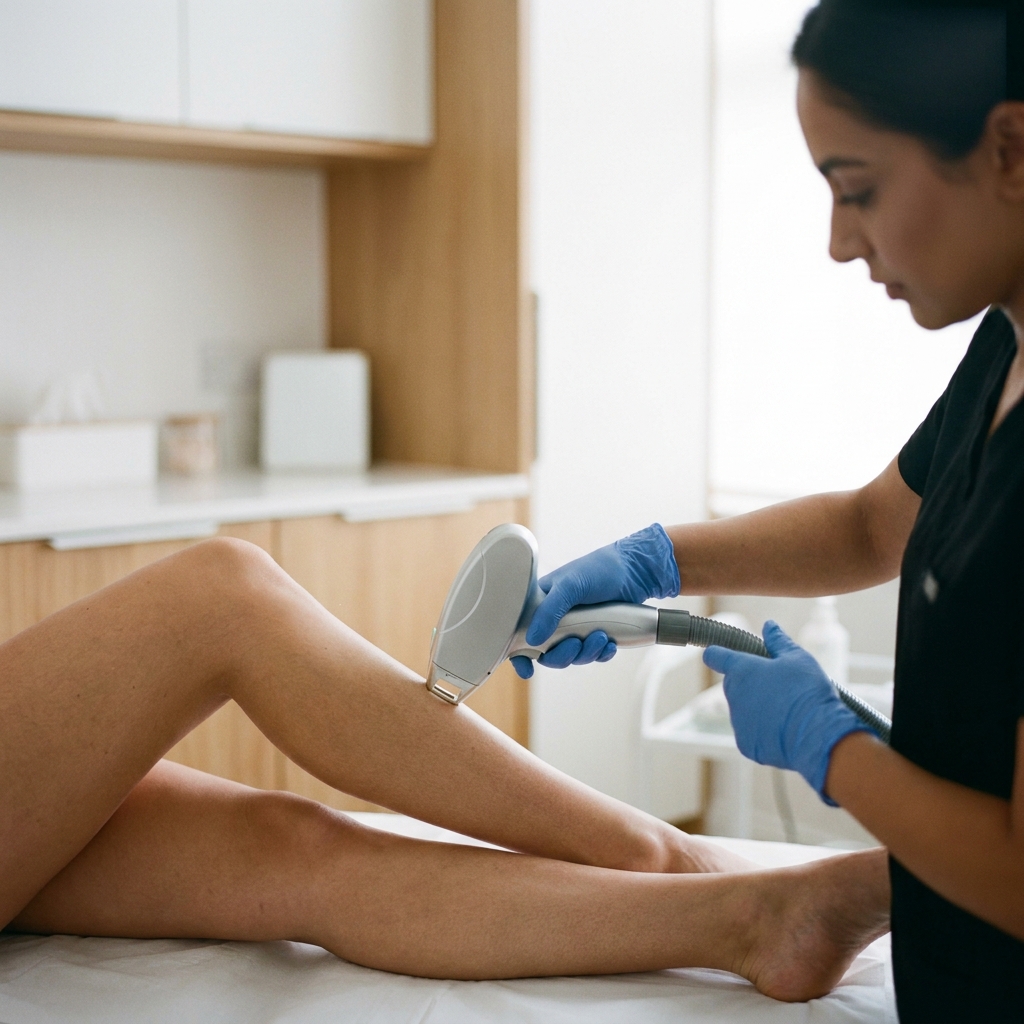
The treated area is usually shaved beforehand so the energy goes into the follicle, not the visible hair above the skin. The practitioner glides or presses the handpiece across the area, firing pulses; most people describe the sensation as a quick warm snap, like an elastic band against the skin. Sessions for a small area can take a few minutes; larger areas take longer. Afterwards the skin may look slightly pink, similar to mild sunburn, which usually settles within a day or two.
How a course is structured over time
Because of the growth-cycle limitation, laser hair removal is delivered as a planned course rather than a single appointment. A practitioner assesses the area, your skin tone and hair colour, then sets out a schedule. Typical patterns in the UK look like this:
| Stage | What happens | Typical timing |
|---|---|---|
| Consultation & patch test | Suitability assessed; small test area treated | Before the course starts |
| Main course | Repeated sessions catch follicles in their growth phase | 6–8 sessions, 4–8 weeks apart |
| Review | Progress checked; plan adjusted | During and after the course |
| Maintenance | Occasional top-ups manage regrowth | As needed afterwards |
The spacing is deliberate, not arbitrary: leaving several weeks between sessions allows a fresh batch of follicles to enter the anagen phase, so each appointment is productive. Sessions placed too close together waste energy on hair the laser cannot yet affect. Smaller areas such as the upper lip or underarms take only a few minutes per session, while larger areas such as legs or back take longer, and the total cost of a course reflects this. Weighed against the never-ending cost of waxing, many people find the long-term arithmetic favourable.
What it can and cannot promise
Used correctly, laser hair removal delivers a long-term reduction in hair — finer, sparser, slower regrowth across the treated area. What it does not promise is the permanent removal of every single hair forever. Hormones, age and individual biology mean some regrowth or new growth is common, which is why maintenance is often part of the picture. Anyone promising ‘permanent’ total removal is overstating the evidence. Set against waxing or shaving, the appeal is durability rather than perfection — see how it compares with waxing and IPL.
It is also worth being clear about what laser hair removal is not. It is not a one-off fix, it is not effective on hair that lacks pigment, and it is not a treatment to begin without a proper assessment of your skin and medical history. Certain medications, skin conditions, recent sun exposure or a fresh tan can all affect suitability, which is exactly why a consultation and patch test come first. Approached realistically — the right device for your skin, a complete course, honest expectations — it is one of the most effective ways to reduce unwanted hair over the long term.
Frequently asked questions
Does laser hair removal hurt?
Most people feel a quick warm snap, often compared to an elastic band flicking the skin, with built-in cooling to ease it. Comfort varies by area and pain threshold; a practitioner can discuss numbing options at your consultation.
How soon will I see results?
Treated hairs often shed over one to three weeks after a session, and you should notice gradually thinner, sparser regrowth across the course. Full results build over several sessions because the laser only affects hair in its active growth phase.
Can it remove all my hair permanently?
No. Laser hair removal achieves long-term hair reduction rather than guaranteed permanent removal of every hair. Hormonal changes and new follicle activity mean some regrowth is normal, so maintenance sessions are often needed.
Is it safe on the face?
Facial laser hair removal is widely offered, but the skin is delicate and pigment varies, so it must be done by a qualified practitioner after a patch test. Discuss any skin conditions or medication with them beforehand.
Sources & further reading
- NHS — Cosmetic procedures: laser hair removal and IPL
- MHRA — Guidance on lasers, intense light sources (IPL) and LEDs
- British Medical Laser Association (BMLA) — Patient information on laser treatments
- Joint Council for Cosmetic Practitioners (JCCP) — Public guidance on choosing a practitioner
This guide is general information, not medical advice. A patch test and consultation with a qualified, regulated practitioner are essential before treatment, and results vary by individual. Laser achieves long-term hair reduction, not guaranteed permanent removal of every hair. Discuss any skin or health concerns with the practitioner or your GP.