The short answer
The key difference is the light: a laser emits a single, focused wavelength, while IPL (intense pulsed light) emits a broad spectrum of wavelengths like a very bright flash. Both heat the pigment in the hair to slow regrowth, but a laser’s concentrated beam is more precise and is often preferred for darker skin tones. IPL covers a wider area per pulse and is common in salons and home devices. Both need a consultation and patch test, and both deliver reduction rather than guaranteed permanence.
‘Laser’ and ‘IPL’ are often used interchangeably in adverts, but they are not the same technology. Both rely on light absorbed by the pigment in your hair, yet the type of light differs in a way that affects precision, suitability for different skin tones, and where you are likely to encounter each. This page sets out the real distinction and how to think about choosing between them.
Laser vs IPL at a glance
- Laser light Single, coherent wavelength
- IPL light Broad spectrum (many wavelengths)
- Precision Laser is more focused; IPL is more scattered
- Darker skin Laser (esp. Nd:YAG) often preferred
- Common settings Laser in clinics; IPL in salons & home devices
- Both deliver Long-term reduction, not permanence
The core difference is the light itself
The simplest way to understand the two is to look at the light each produces. A laser emits a single, pure wavelength of light, all travelling in the same direction — coherent and tightly focused. IPL, which stands for intense pulsed light, is not a laser at all: it fires a broad spectrum of wavelengths in a bright pulse, more like a very powerful camera flash filtered to a useful range.
Both work on the same underlying principle described in how laser hair removal works: light is absorbed by the melanin in the hair, converted to heat, and that heat damages the follicle. The difference is precision. A laser’s single wavelength can be chosen to match the target tightly, while IPL’s scattered spectrum spreads its energy across more of the skin and hair.
How that difference plays out
Because a laser is focused, more of its energy reaches the intended target, which can make treatment more efficient per follicle and more controllable on a range of skin tones. IPL covers a larger patch of skin with each pulse, so it can be quicker over big areas, but its broad light is absorbed by skin pigment more readily — one reason practitioners often steer people with darker skin towards a laser, particularly an Nd:YAG device.
| Feature | Laser | IPL |
|---|---|---|
| Light type | Single focused wavelength | Broad spectrum of wavelengths |
| Precision | Higher — targeted | Lower — scattered |
| Area per pulse | Smaller, more controlled | Larger |
| Darker skin tones | Often preferred (Nd:YAG) | Higher caution needed |
| Typical setting | Clinics | Salons & home devices |
Where you’ll find each
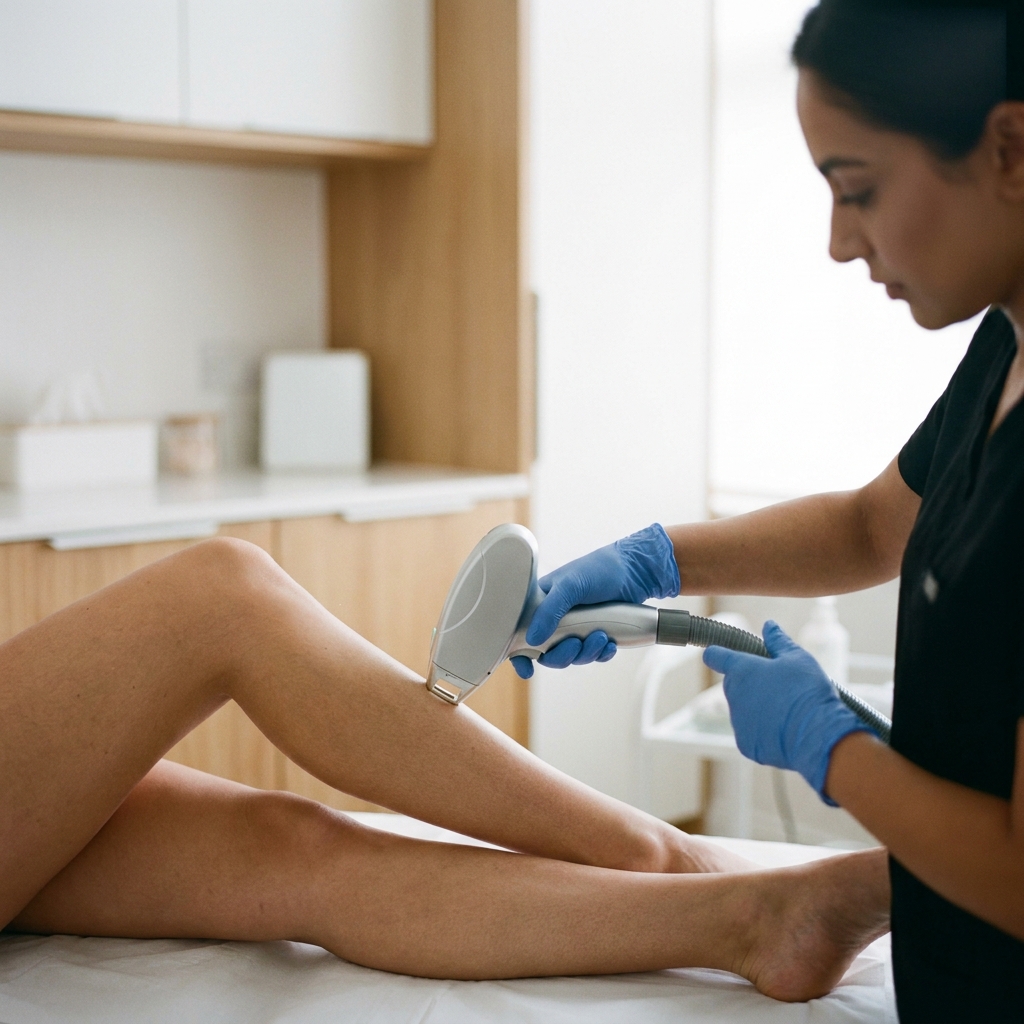
In the UK, true lasers are usually found in clinics and medical settings, operated by trained practitioners. IPL is widely used in beauty salons and is the technology inside most at-home hair-removal gadgets, which are deliberately set to lower energy levels for safety. Both clinic and home options have a role, but they differ sharply in power, oversight and results — see our guide to clinic versus home devices.
- Clinic laser — higher energy, practitioner-controlled, suited to a tailored course.
- Salon IPL — convenient and often lower cost, but check the operator’s training.
- Home IPL — lower power for safety, slower results, useful for maintenance.
What stays the same either way
For all the talk of differences, it is important not to lose sight of how much laser and IPL share. Both rely entirely on pigment in the hair, so both struggle with blonde, red, grey or white hair that contains little melanin. Both work only on hair in its active growth phase, which is why both need a course of several sessions spaced weeks apart rather than a single visit. Both deliver long-term reduction rather than guaranteed permanent removal of every hair. And both require a patch test and a sensible aftercare routine, including avoiding sun exposure around treatment. In other words, the headline choice of technology sits on top of a shared set of rules that neither can escape.
- Pigment-dependent — neither works well on light-coloured hair.
- Course-based — both need repeated sessions to catch hair in growth.
- Reduction, not permanence — maintenance may still be needed afterwards.
- Patch test first — essential for either technology, on any skin tone.
Which should you choose?
There is no single ‘better’ option for everyone. The right choice depends on your skin tone, hair colour, the area being treated, your budget and how much oversight you want. People with darker skin, or those wanting a closely managed clinical course, often favour laser. Those after a quicker, lower-cost route over large areas may consider professional IPL. Whichever you pick, the deciding factors are the same as for laser generally — see whether the treatment works for you and discuss it at a consultation with a patch test before committing.
Frequently asked questions
Is IPL a type of laser?
No. IPL stands for intense pulsed light and uses a broad spectrum of wavelengths, whereas a laser emits a single focused wavelength. They work on the same melanin-heating principle but are different technologies.
Which is better for darker skin?
Lasers, particularly Nd:YAG devices, are generally preferred for darker skin because their focused, longer wavelength is absorbed less by skin pigment. IPL’s broad light carries a higher risk on darker tones, so a careful consultation and patch test are essential.
Is home IPL as effective as clinic laser?
Home IPL devices are set to lower energy for safety, so results are usually slower and less complete than a clinic laser course. They can be useful for maintenance, but a professional consultation gives a realistic picture.
Do both laser and IPL need multiple sessions?
Yes. Both only affect hair in its active growth phase, so a course of several sessions spaced weeks apart is needed, typically six to eight, sometimes more, with occasional maintenance afterwards.
Sources & further reading
- NHS — Cosmetic procedures: laser hair removal and IPL
- MHRA — Lasers, intense light sources (IPL) and LEDs: guidance
- British Medical Laser Association (BMLA) — Information on light-based hair removal
- Chartered Institute of Environmental Health (CIEH) — Guidance on cosmetic light treatments
This guide is general information, not medical advice. A patch test and consultation with a qualified, regulated practitioner are essential before treatment, and results vary by individual. Laser achieves long-term hair reduction, not guaranteed permanent removal of every hair. Discuss any skin or health concerns with the practitioner or your GP.