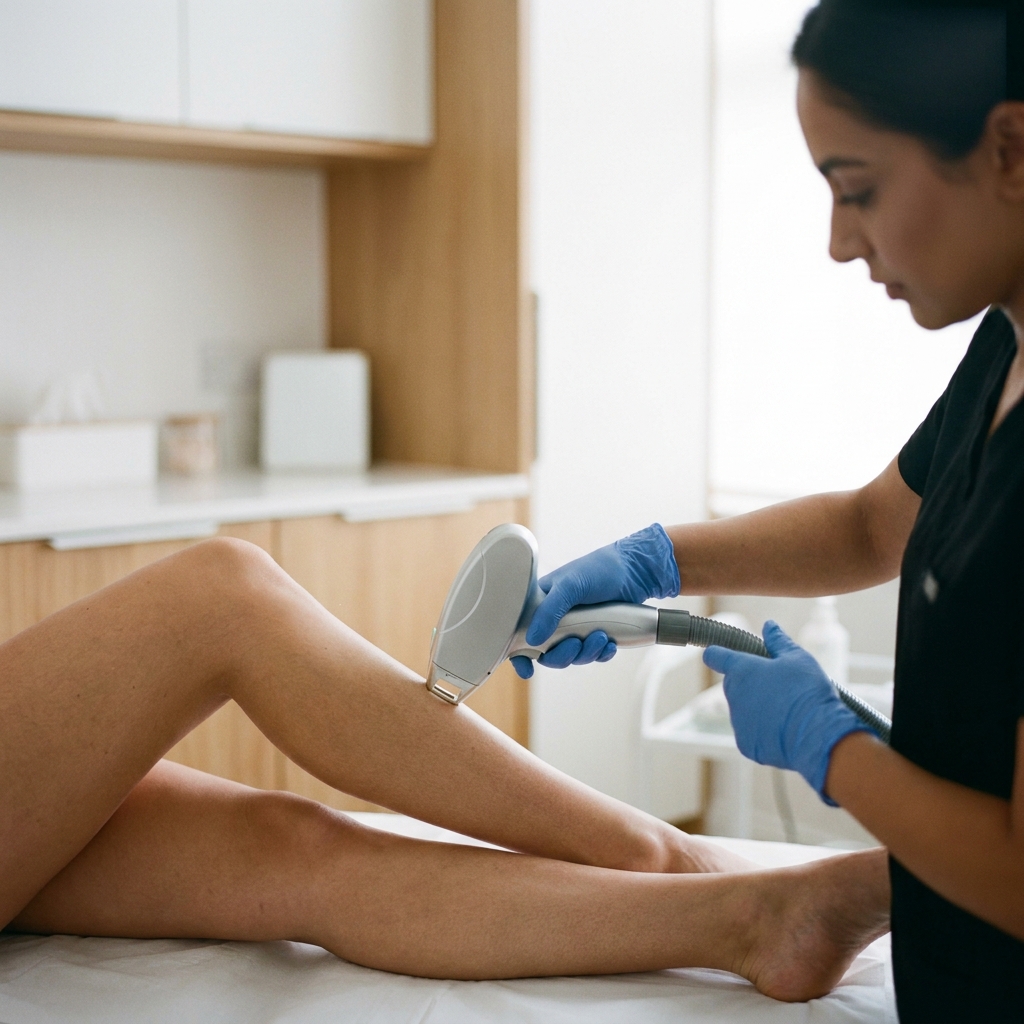
The short answer
Expect roughly £50–£150 per session for a small area such as the upper lip or underarms, with larger areas like legs, back or a full body costing more. Because a typical course runs to 6–8 sessions (sometimes more), the total matters more than the headline per-session price. Many clinics sell discounted courses or packages that work out cheaper than paying session by session. Prices vary widely by area, clinic and region, so always confirm a quote at consultation.
Laser hair removal is priced two ways — per session and as a pre-paid course — and the area being treated is the single biggest driver of the figure. This page sets out the typical 2026 UK ranges, explains why a course is usually better value, and lists what to check before you pay. It is general information, not medical advice; a consultation and patch test with a qualified practitioner are essential.
Laser hair removal cost at a glance
- Small area, per session Roughly £50–£150
- Typical course 6–8 sessions, sometimes more
- Session spacing Every 4–8 weeks
- Best value Pre-paid course or package
- Biggest price driver Size of the treatment area
- Outcome Long-term reduction, not guaranteed permanence
There is no single national price for laser hair removal in the UK. Clinics set their own fees, and what you pay depends mainly on how large the treatment area is, how many sessions your hair and skin need, and where in the country the clinic is. As a guide, a small area such as the upper lip, chin or underarms tends to cost roughly £50–£150 per session, while larger areas — legs, back, chest or a full body — cost considerably more per visit. Because of this variation, treat any advertised price as a starting point and confirm the figure for your own treatment at a consultation.
Per session versus a course
Because the laser only affects hair that is in its active growth phase, a single session never clears an area permanently. A course is normally 6–8 sessions (some people need more), spaced several weeks apart, so the meaningful number is the total cost of the course rather than the price of one visit. Most clinics recognise this and sell pre-paid packages that work out cheaper per session than booking individually. When you compare clinics, the question to ask is not “what is one session?” but “what will the whole course cost?”
- Pay-as-you-go: flexible, but the most expensive route per session.
- Course of 6–8: usually discounted; commits you to one clinic.
- Maintenance top-ups: occasional later sessions to catch regrowth, charged singly.
The reason a course is unavoidable lies in the hair growth cycle. At any one time only some of your follicles are actively growing, and those are the ones the laser can disable. Returning every few weeks lets the laser catch successive batches as they enter that phase. This is also why you cannot simply pay for one expensive session and expect a lasting result — the biology, not the clinic, sets the number of visits. Our how many sessions page explains the count in full.
What changes the price
Several factors push the figure up or down. Larger and denser areas take longer and use more of the practitioner’s time. Skin tone and hair colour affect how many sessions you are likely to need, which changes the overall outlay — dark, coarse hair responds best, while blonde, red, grey or white hair contains little pigment and responds poorly. The device used matters too: modern systems with larger applicators and integrated cooling can treat an area faster. Location is a significant factor as well; clinics in central London and other large cities typically charge more than those in smaller towns.
| Area size | Examples | Typical per session |
|---|---|---|
| Small | Upper lip, chin, underarms | Roughly £50–£150 |
| Medium | Bikini, lower arms, half legs | More than a small area |
| Large | Full legs, back, chest, full body | The highest per-session prices |
These are typical market ranges, not fixed prices. A full breakdown is on our cost by area page, and the per-session detail sits on the cost per session guide.
How to budget sensibly
Work out the likely total, not the single-session figure. Ask the clinic, at consultation, how many sessions they expect you to need and what a full course will cost including any maintenance. The number of sessions varies by individual, which is covered on our how many sessions page. A useful exercise is to set the total course cost against what you currently spend on shaving, waxing or salon appointments over several years; for many people with dark hair the comparison is favourable, which we explore on our is it worth it page. Remember that laser hair removal delivers long-term hair reduction rather than guaranteed permanent removal of every hair, so factor in occasional top-ups over time.
Finally, the NHS does not normally fund cosmetic laser hair removal; it is paid for privately. In rare exceptional or medically linked cases — for example some cases linked to a diagnosed condition — your GP can advise, but you should not assume NHS funding. If you want to spread the cost across a payment plan rather than paying up front, see our financing guide. Whatever route you choose, a consultation and patch test should always come first, because they confirm whether laser is suitable for you before any money is committed. This page is general information, not medical advice, and results vary from person to person.
Frequently asked questions
Is laser hair removal available on the NHS?
The NHS does not normally fund cosmetic laser hair removal — it is a private treatment. Only rare exceptional or medically linked cases may be considered, so speak to your GP if you think your situation is unusual.
Why is a course cheaper than single sessions?
Clinics discount pre-paid courses because they secure your repeat business and because a course is the realistic way to get results. Paying per session is more flexible but costs more overall.
Does the price include a consultation and patch test?
Sometimes, but not always. Ask before booking. A patch test and consultation with a qualified practitioner are essential to check suitability and reduce the risk of a skin reaction.
Will I need to pay for maintenance later?
Possibly. Laser hair removal gives long-term reduction rather than permanent removal of every hair, so occasional maintenance sessions may be needed and are usually charged individually.
Sources & further reading
- NHS — Cosmetic procedures: laser hair removal and IPL
- MHRA — Lasers, intense light source systems and LEDs: guidance on safe use
- JCCP — Joint Council for Cosmetic Practitioners register and standards
- CIEH — Special treatment premises and local authority licensing
This guide is general information, not medical advice. A patch test and consultation with a qualified, regulated practitioner are essential before treatment, and results vary by individual. Laser achieves long-term hair reduction, not guaranteed permanent removal of every hair. Discuss any skin or health concerns with the practitioner or your GP.