The short answer
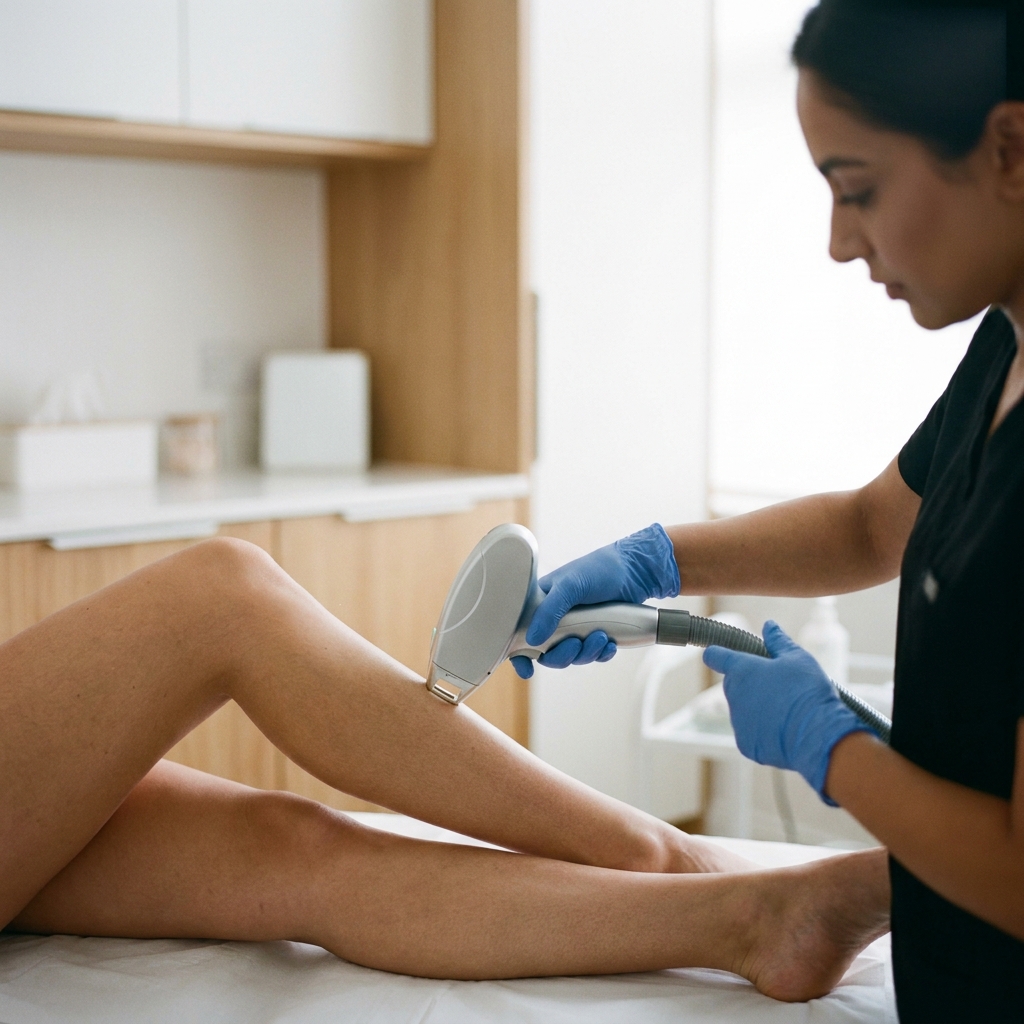
Lasers target hair through selective photothermolysis: a precise wavelength of light is absorbed by the melanin pigment in the hair and follicle, then converted to heat that damages the follicle. The wavelength and pulse are tuned so the hair heats far more than the surrounding skin, and cooling protects the surface. Because only hair in its active growth phase is firmly linked to its pigment-rich root, the laser only damages follicles in that phase — which is why a course of sessions is needed.
To understand laser hair removal properly, it helps to understand the physics underneath it. The whole procedure rests on a single, elegant idea — that you can choose a colour of light absorbed mostly by one target and use it to deliver heat exactly where you want it. This page goes a level deeper than the basics, explaining melanin absorption, selective photothermolysis and the growth cycle that dictates how the treatment is timed.
The targeting science at a glance
- Target molecule Melanin (pigment) in the follicle
- Principle Selective photothermolysis
- Energy path Light → absorbed by melanin → heat
- Skin protection Cooling + chosen wavelength & pulse
- Timing Works on hair in the anagen (growth) phase
- Consequence Multiple spaced sessions required
Melanin: the molecule the laser is aiming for
The target of every hair-removal laser is melanin — the pigment that colours both hair and skin. Melanin happens to absorb certain wavelengths of light very strongly. When a laser fires light of the right colour at the skin, the melanin packed into the hair shaft and the follicle soaks up that energy far more efficiently than the surrounding tissue does. This selective absorption is what makes the whole procedure possible, and it is why hair colour matters so much, as our does it work page explains.
Once absorbed, the light energy has to go somewhere — and it becomes heat. The melanin-rich follicle heats up rapidly, and that heat damages the structures responsible for growing new hair. The skin around it, with much less melanin in the right place, stays comparatively cool.
Selective photothermolysis explained
The formal name for this process is selective photothermolysis, and it has three ingredients that all have to be right:
- Wavelength — chosen so it is absorbed strongly by hair melanin and reaches the depth of the follicle. Different lasers use different wavelengths, which is why there are several types of laser.
- Pulse duration — the light is delivered in a short burst long enough to heat the follicle but short enough that the heat does not spread and damage surrounding skin.
- Cooling — the handpiece cools the skin surface so the energy is concentrated in the follicle, protecting the outer layer.
Get these right and the laser damages the follicle while sparing the skin. Get them wrong — the wrong wavelength for a skin tone, too much energy — and the risk of burns or pigment changes rises, which is why device choice for your skin is a clinical decision covered in different skin tones.
Why timing depends on the growth cycle
Hair grows in cycles, and the laser can only do its job at one stage. Each follicle moves through:
| Phase | What happens | Laser effect |
|---|---|---|
| Anagen | Active growth; hair linked to pigment-rich root | Most effective |
| Catagen | Transition; growth slows | Limited |
| Telogen | Resting; hair detached and shedding | Largely ineffective |
Only in anagen is the hair firmly connected to the pigment-rich root the laser needs to heat. Because only a fraction of your hair is in anagen at any one time, a single session cannot reach every follicle — hence a course of several treatments, spaced weeks apart, to catch successive batches as they enter their growth phase.
Why the laser misses some hair colours entirely
The dependence on melanin is also why certain hair colours are effectively invisible to the laser. Blonde, red, grey and white hair contain little or no melanin, so when the light arrives there is almost nothing to absorb it and convert it to heat. The energy passes through without doing its job, which is why results on those colours are poor regardless of how powerful the device is or how skilled the practitioner. This is not a flaw that newer machines have fixed; it is a direct consequence of the physics of selective photothermolysis. For hair colours the laser cannot target, people often consider electrolysis instead, which works by an electrical current rather than light absorption and is therefore colour-independent — see laser vs electrolysis.
- Dark hair — rich in melanin, the ideal target.
- Light hair — little melanin, little to absorb the light, poor results.
- Skin pigment — also absorbs light, which is why device choice protects darker skin.
What the science means in practice
Understanding the targeting explains the rules of the treatment: it works best on dark hair (lots of melanin) against treatable skin; it fails on blonde, red, grey or white hair (almost no melanin); it needs the right wavelength for your skin tone; and it must be repeated to catch hair in its growth phase. All of these follow directly from the physics. For how the wavelengths differ in practice, see diode vs alexandrite vs Nd:YAG, and discuss your own skin and hair at a consultation with a qualified practitioner.
Frequently asked questions
What exactly does the laser target?
It targets melanin, the pigment in the hair and follicle. Melanin absorbs the laser’s light strongly and converts it to heat, which damages the follicle. This is why dark, pigmented hair responds best.
What is selective photothermolysis?
It is the principle behind laser hair removal: using a chosen wavelength, pulse length and cooling so the light heats the hair’s pigment far more than the surrounding skin, damaging the follicle while sparing the surface.
Why can’t the laser treat all my hair in one go?
Because the laser only effectively damages hair in its active growth phase, and only a fraction of follicles are in that phase at any time. A course of spaced sessions catches successive batches as they grow.
Why is the laser less effective on darker skin?
Skin pigment also absorbs the laser’s light, which can raise the risk of side effects. Longer-wavelength lasers such as Nd:YAG pass more safely through surface pigment, so device choice and a patch test are essential.
Sources & further reading
- NHS — Cosmetic procedures: laser hair removal and IPL
- MHRA — Lasers, intense light sources (IPL) and LEDs: guidance
- British Medical Laser Association (BMLA) — Science of laser-tissue interaction
- Chartered Institute of Environmental Health (CIEH) — Guidance on light-based treatments
This guide is general information, not medical advice. A patch test and consultation with a qualified, regulated practitioner are essential before treatment, and results vary by individual. Laser achieves long-term hair reduction, not guaranteed permanent removal of every hair. Discuss any skin or health concerns with the practitioner or your GP.